
Underfloor Heating Installation in a Dunmow Extension
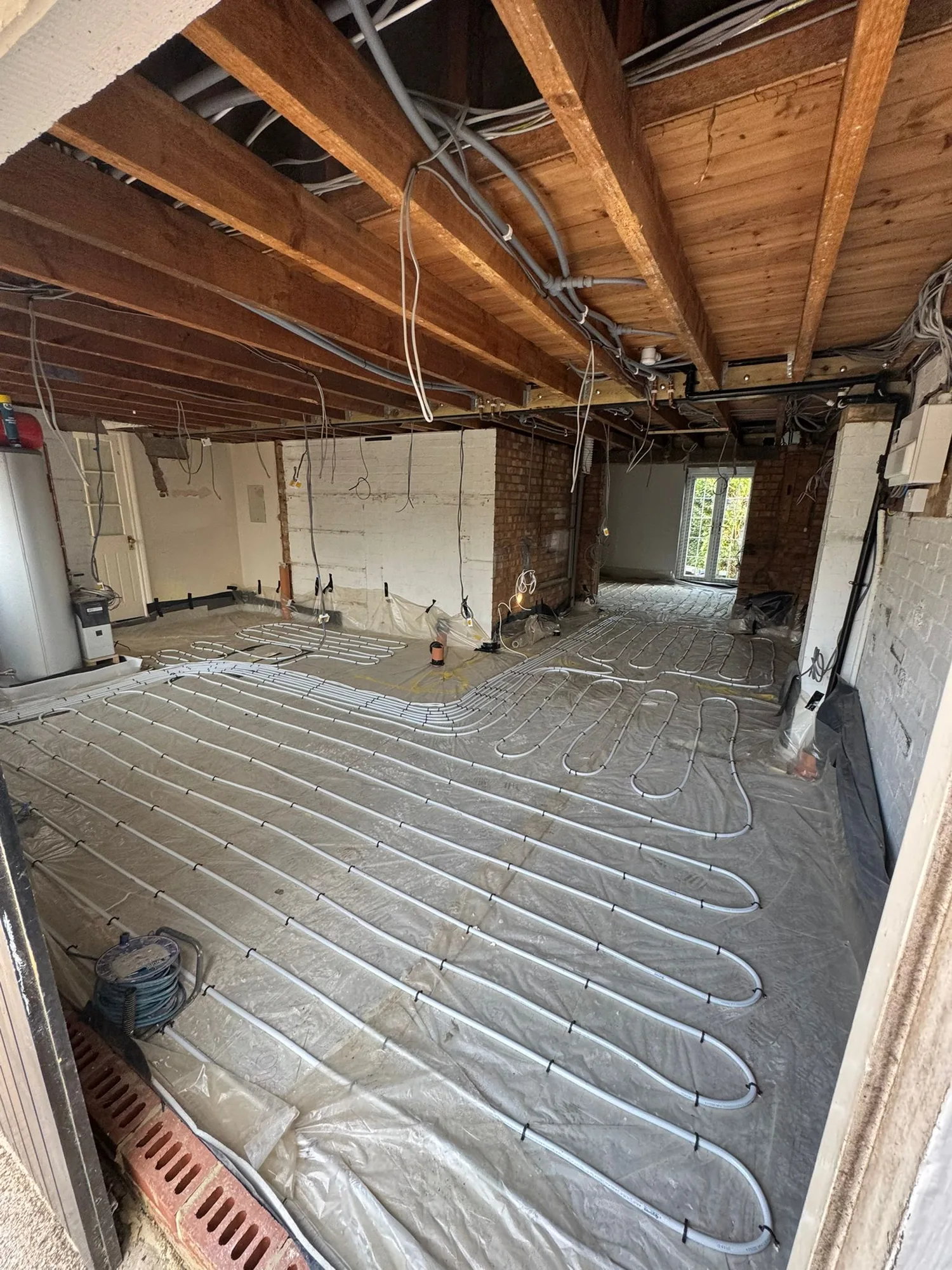
Wet UFH installed ahead of the screed pour on an open-plan build
The Brief
A couple in Dunmow had spent around two years planning their extension. They were taking out the back wall of the house to create an open-plan kitchen and dining room roughly four times the size of the old space. They'd thought carefully about the layout, the bifold doors, the kitchen units, the lighting. They had not given much thought to how they were going to heat it.
The Heating Problem
Open-plan rooms with bifold doors have a specific heating challenge. Available wall space starts to disappear once you lose walls to the doors, the kitchen run and the structural opening. By the time the room is properly designed, a conventional radiator layout either doesn't fit comfortably or ends up in positions that don't make sense for heating the space evenly. Thomas was brought in by the groundwork contractor to quote on underfloor heating early in the build, before the slab went down. That timing mattered. Once the concrete is poured, the options narrow and the costs go up significantly.
How the System Was Designed
Thomas specified a wet (hydronic) underfloor heating system. Pipes laid in the floor, connected to a manifold in the utility room, running off the couple's existing gas boiler. Warm water circulates at a lower temperature than a standard radiator circuit, heating the floor from below, which then radiates heat evenly across the room. The floor finish the couple had chosen, large-format porcelain tile, is one of the best conductors for underfloor heat, so there was nothing in the spec that conflicted with the system.
The Work, Visit by Visit
The installation happened in two site visits, timed to the builder's schedule:
- Visit 1 (before the screed pour): Thomas laid the pipework across the footprint of the extension over the better part of a day, then pressure-tested the pipes. That's the point where any faults need to be found, not afterwards. The groundworkers finished over the pipework without any issues.
- Visit 2 (after the floor finish): once the tile was laid and the room was habitable, Thomas returned to commission the manifold and controls. The smart thermostat was paired to the system, zones were configured for the kitchen and dining area, and the whole circuit was tested under load.
The Smart Thermostat Question
The question the couple came back to most often during design was the warm-up time. They wanted to know whether the room would take too long to reach temperature to be practical. The honest answer is that underfloor heating is slower than radiators. You can't switch it on at 6:30am and expect the floor to be warm by 7:00am. But it also takes time to cool down, which means it holds heat well once it's there. A smart thermostat solves the timing concern directly. It learns the warm-up time over the first few weeks and starts heating the floor well before the room needs to be at temperature. Within a few weeks the system was working without them having to think about it.
The Result
What the couple said afterwards was essentially this: they couldn't imagine having done it differently. The room heats evenly from one end to the other, including the corners near the bifold doors that would have been difficult to reach with radiators. They've reclaimed all the wall space for the kitchen layout. Their energy use for that part of the house came in lower than they'd expected, partly because the insulation under the slab was done properly and partly because the lower water temperature means the boiler runs more efficiently for the underfloor circuit than it does for the radiators in the rest of the house.
Job Duration: One day for the pipework install before the screed; a half-day for commissioning after the floor was finished.
Gallery
Planning an Extension with Underfloor Heating?
Call Thomas on 07774 323248 to discuss your project early, before the groundwork closes.
Contact Us